20.0.0.1 Admin Login: Easy Access & Setup Guide
Open 20.0.0.1 the right way. Log in, change your WiFi name and password, set up a captive portal, and fix login errors — simple steps for 2026.
Open the portal
Open 20.0.0.1
Accessing 20.0.0.1 is your key to a router or networking device's control panel. From there you configure WiFi networks, passwords, captive portals, connected devices, and security settings. You will see this address in home labs, enterprise VLAN configurations, Cisco simulation setups, and custom-configured routers where the administrator has set 20.0.0.1 as the gateway.
This guide covers login procedures, brand-specific credentials, fixes for common issues, and the security settings you should change.
What Is 20.0.0.1?
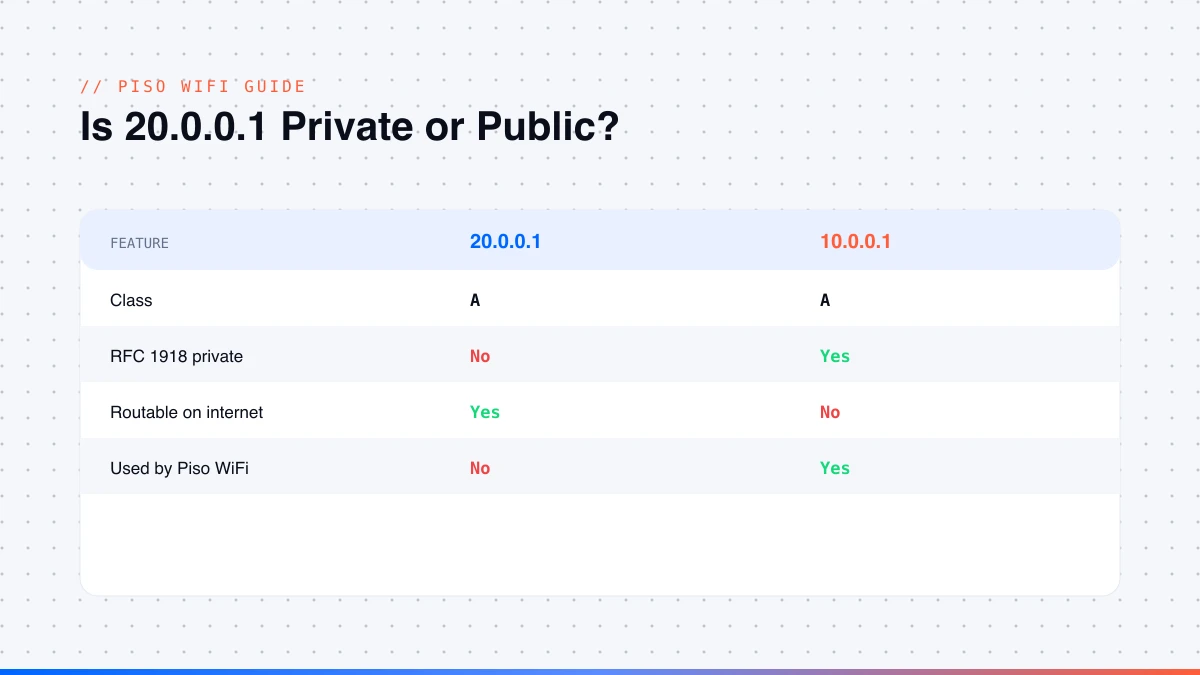
20.0.0.1 belongs to the Class A group of IP addresses. Unlike 192.168.1.1 or 10.0.0.1, it is not a private IP under RFC 1918 — it sits in the public 20.0.0.0/8 block, which is routable over the internet.
Is 20.0.0.1 Private or Public?
This address is publicly classified but is safely used inside private network environments.
- Network Address:
20.0.0.0 - Default Subnet Mask:
255.0.0.0(/8) - Host Range:
20.0.0.1to20.255.255.254 - Broadcast Address:
20.255.255.255 - Maximum Hosts: 16,777,214
- IP Class: Class A, publicly routable
In an enclosed network — an intranet or lab — traffic directed at 20.0.0.1 stays inside the network and does not reach the internet unless it is appropriately segmented. If you see 20.0.0.1 as your gateway, it was manually configured by an administrator. Confirm it with ipconfig /all on Windows or ip route on Linux/Mac.
How to Log In to 20.0.0.1
Logging in is the same across devices — you just need to be on the right network first.
- Connect your device to the network managed by the
20.0.0.1router, via WiFi or Ethernet. - Open any browser — Chrome, Firefox, Edge, and Safari all work.
- Type
http://20.0.0.1in the address bar and press Enter. Do not search for it. - A login page appears. Enter your username and password — the default for most devices is
adminfor both fields. - Click Login or Sign In to reach the admin dashboard.
If the page loads but credentials fail, check the label on the back or bottom of your router.
Default Login Credentials by Router Brand
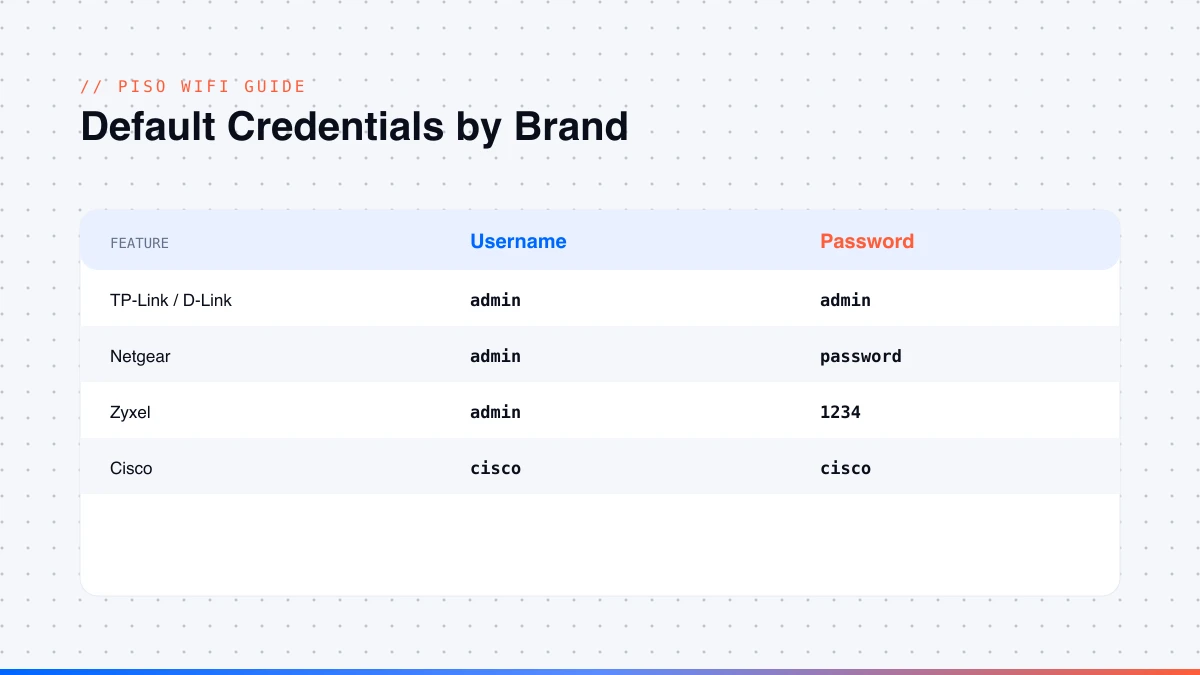
| Router Brand | Default Username | Default Password |
|---|---|---|
| TP-Link | admin | admin |
| D-Link | admin | admin |
| Netgear | admin | password |
| Linksys | admin | admin |
| Asus | admin | admin |
| Huawei | admin | admin |
| Zyxel | admin | 1234 |
| Cisco | cisco | cisco |
Some routers leave the password field blank by default. If none of the above work, try leaving it empty. If that fails too, the credentials were changed and you will need to factory reset.
20.0.0.1 Pause Time
A lot of people search for "20.0.0.1 pause time" expecting a session-management feature. Here is the honest answer: the pause time feature belongs to the 10.0.0.1 portal used by Piso WiFi vending machines in the Philippines — not to 20.0.0.1 admin panels.
When a user pays for Piso WiFi access, the session timer starts. The pause feature freezes that timer so unused minutes are not lost. It is controlled entirely by the vendo machine owner. For the full walkthrough, read our 10.0.0.1 admin login guide or the complete pause time guide.
If you are a Piso WiFi user: connect to the network, go to http://10.0.0.1, find the Pause Time button, tap it to stop your timer, and tap Resume Time when ready. The button only appears if the vendo owner enabled it — if it is missing, see why the pause button is not showing.
How to Change Your WiFi Name and Password
Updating your SSID and password via the 20.0.0.1 panel takes under five minutes and should be one of the first things you do after setup.
- Go to
http://20.0.0.1and log in. - Find Wireless Settings, WiFi Settings, or WLAN (the label varies by brand).
- Edit the SSID field — keep it unique but without your name or address.
- Edit the Password or Security Key field — a strong password uses at least 12 characters.
- Click Save or Apply. The router reboots and applies the changes.
- Reconnect all devices with the new name and password.
How to Access 20.0.0.1 on Any Device
| Device | Browser | Quick Tip |
|---|---|---|
| Windows PC | Chrome or Edge | Run ipconfig to confirm 20.0.0.1 is your gateway |
| Mac | Safari or Chrome | Use ip route in Terminal to verify the gateway |
| Android | Chrome | Turn off mobile data, connect to WiFi, then open the browser |
| iPhone / iPad | Safari | WiFi must be active, not cellular |
| Linux | Firefox or Chrome | Run ip route, look for via 20.0.0.1 |
| Smart TV | Built-in browser | Ensure the TV is on the same WiFi as the router |
How to Confirm 20.0.0.1 Is Your Actual Gateway
Before troubleshooting a login, confirm 20.0.0.1 is actually your gateway. On Windows run ipconfig /all and read the Default Gateway line. On Mac or Linux run ip route and look for via 20.0.0.1. On Android check WiFi → network → advanced → Gateway. On iPhone, Settings → WiFi → network → Router field. If the gateway shows a different IP, use that one instead.
Troubleshooting 20.0.0.1 Access Issues
Page not loading: confirm you are on the correct network, clear cache and cookies, try a different browser, and restart the router (unplug 15 seconds, plug back in).
Wrong username or password: try the brand defaults above, check the router label, or factory reset if you changed and forgot them.
Connection refused or IP conflict: verify 20.0.0.1 is your gateway with ipconfig /all or ip route, check for a duplicate IP on the network, and in enterprise environments a firewall rule may block HTTP — try https://20.0.0.1 and check with your network admin.
Admin panel not loading after login: clear cache and try an incognito window, check firmware is current, and try a different device on the same network.
How to Change the Admin Password
The default admin password is publicly known. Leaving it unchanged means anyone on your network can access your router settings.
- Log in at
http://20.0.0.1. - Open Administration, Management, System, or Security.
- Find Change Password or Admin Password.
- Enter a new password twice — at least 12 characters with letters, numbers, and symbols.
- Click Save or Apply.
- Log out and back in to confirm it works.
Do not reuse your WiFi password as the admin password — keep them separate.
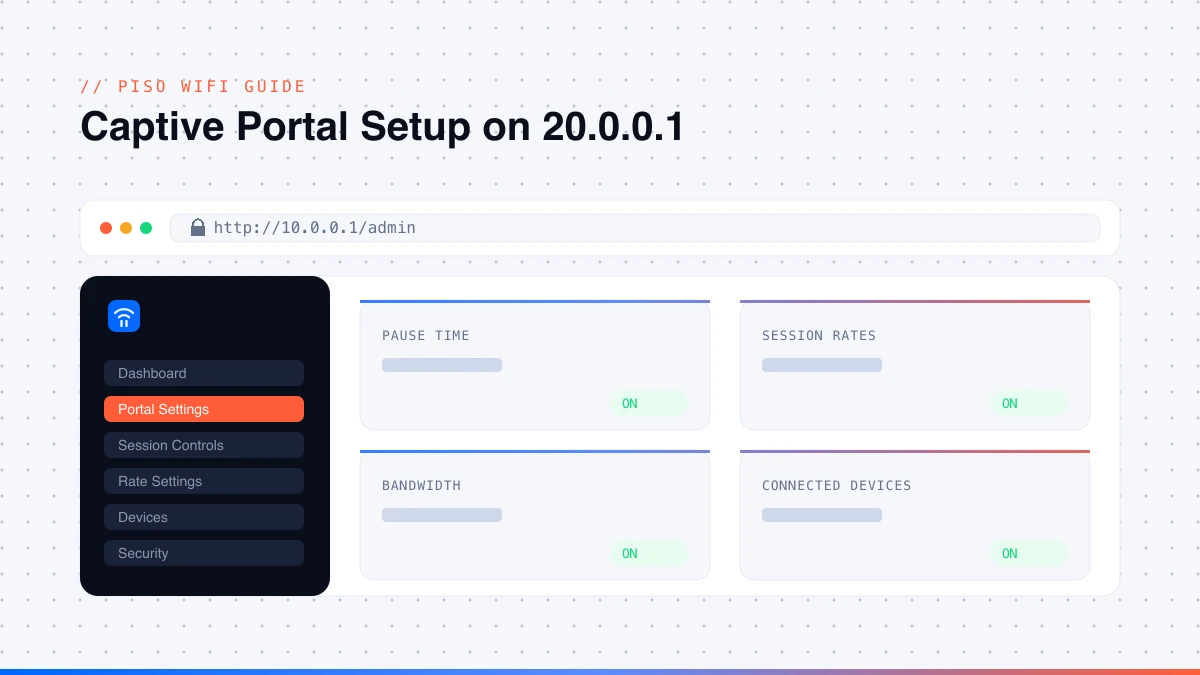
Captive Portal Setup on 20.0.0.1
A captive portal is the login screen that appears when you connect to a network — used in hotels, cafés, and businesses to make users accept terms, enter a code, or pay for access.
- Open
http://20.0.0.1. - Navigate to Captive Portal, Hotspot Settings, or Guest Portal.
- Turn the captive portal on.
- Choose what it requests — terms acceptance, a voucher code, or an email.
- Set a session timeout.
- Apply, then verify by connecting another device.
You can configure a custom login page with your business name, terms acceptance, bandwidth limits, session duration, and voucher requirements. This is the same captive-portal concept Piso WiFi vendo machines use — covered in our Piso WiFi vendo machine guide.
Security Settings to Change
Most people log in once to change the WiFi password and stop there. These are the settings that actually protect your network:
- Enable WPA3/WPA2 encryption. Avoid WEP — it is outdated and easily broken.
- Disable remote login unless you specifically need to reach the panel from outside your network.
- Disable WPS — it is convenient but vulnerable; connect devices manually with the WiFi password instead.
- Set up a guest network so visitors reach the internet but not your local devices.
- Review connected devices at Connected Devices or DHCP Client List; if you see a device you do not recognise, reset your WiFi password.
20.0.0.1 vs Other Common Gateway IPs
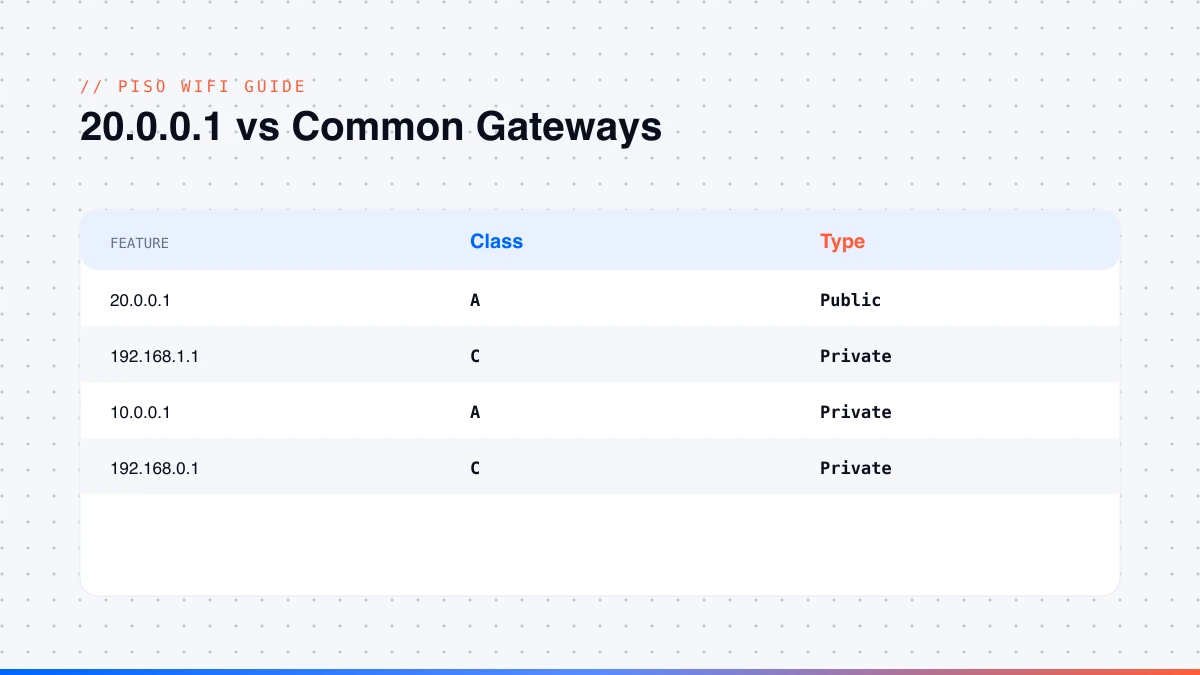
| IP Address | IP Class | Type | Common Use |
|---|---|---|---|
20.0.0.1 | Class A | Public (isolated networks) | Enterprise VLANs, Cisco labs, custom routers |
192.168.1.1 | Class C | Private (RFC 1918) | Home routers, most ISP gateways |
192.168.0.1 | Class C | Private (RFC 1918) | Home and small office routers |
10.0.0.1 | Class A | Private (RFC 1918) | Piso WiFi systems, enterprise networks |
192.168.100.1 | Class C | Private (RFC 1918) | Huawei routers, ISP modems |
If you are on a home network, your gateway is almost certainly 192.168.1.1 or 192.168.0.1. On a Piso WiFi network it is 10.0.0.1 — see our 10.0.0.1 admin login guide. Another uncommon gateway, 10.5.50.1, is covered in our 10.5.50.1 login guide.
Frequently Asked Questions
What is 20.0.0.1 used for?
It is used to access a router or network device's configuration interface, where you set up WiFi, security, connected devices, and other parameters.
Is 20.0.0.1 a private IP address?
No. It belongs to the Class A public range 20.0.0.0/8. Unlike 192.168.x.x and 10.x.x.x, it is not a private address under RFC 1918.
What are the default username and password for 20.0.0.1?
admin for both fields is the most typical default. On some models the username is admin and the password is password or 1234.
Is the pause time feature available on 20.0.0.1?
No. The pause time function works only for the Piso WiFi vending machine portal at 10.0.0.1.
Which routers use 20.0.0.1 as their default gateway?
No major consumer brand uses it by default. It is manually selected in corporate environments, Cisco lab simulations, VLANs, and home lab networks.
Can I access 20.0.0.1 from my phone?
Yes, but only on WiFi on the same network as the router. Turn off mobile data, switch to WiFi, then open http://20.0.0.1.
About the author
Piso WiFi Guide Team
The Piso WiFi Guide Team documents how the 10.0.0.1 portal and admin panel behave across LPB, AdoPiSoft, JuanFi and other firmware, for both users and operators.
Related guides
How to Request a Piso WiFi Vendo Machine Permit (2026)
Register and request a Piso WiFi vendo machine in 2026: NTC VAS permit steps, business permits, machine options, and coin slot calibration.
Read guide →
10.5.50.1 Login: Pause Time, WiFi Control & Admin
Log in to 10.5.50.1 the easy way. Pause and resume your session, change your WiFi name and password, and fix login errors fast — simple 2026 guide.
Read guide →
10.0.0.1 Admin Login: Settings, Passwords & Pause Time
Log in to 10.0.0.1 in minutes. Change your WiFi name and password, turn on Piso WiFi pause time, and fix common login errors — easy step-by-step guide.
Read guide →