
- // 10.0.0.1 · Pause Time
10.0.0.1 Admin Login: Step-by-Step Guide to Pause Piso WiFi Time
QUICK ACCESS PORTALS
Piso WiFi pause time lets you freeze your 10.0.0.1 session and resume later —
without losing a single paid minute.
- Overview
What Is Piso WiFi
Pause Time?
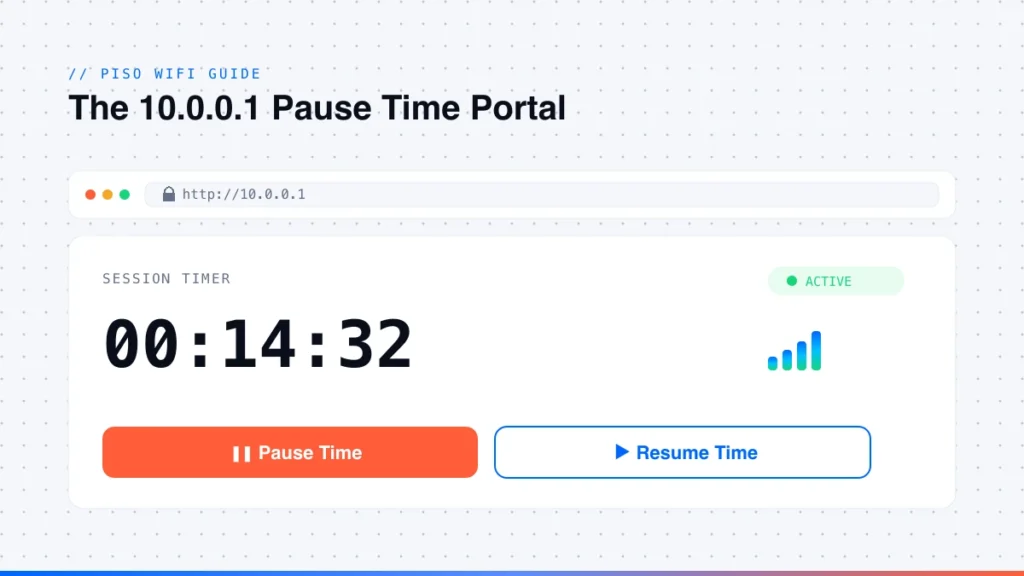
Piso WiFi pause time is a session-control feature built into most Philippine coin-operated and voucher-based WiFi vending machines. It temporarily freezes your internet countdown timer. Your connection is suspended, no data is transferred, and no time is deducted.
When you come back and tap Resume, the timer resumes exactly where it left off. Admins control whether the feature is available, and they can also set limits — such as how long a session can stay paused and how many times a user can pause per session.
- // From the blog
Latest Piso WiFi Guides
Deep dives on admin login, gateway IPs, troubleshooting, and running a Piso
WiFi vendo business.


- // Capabilities
What Does Piso WiFi Pause Time Do?
A clear line between what the feature is built to do and the things it was never
designed for.
What it does
- Freeze your paid session timer completely
- Suspend your internet connection while paused; no data is transmitted
- Store your session ID, remaining time, and device information in the system
- Resume from the exact second you paused, not rounded or reset
- Work across all payment methods: coins, GCash, Maya, voucher codes
What it does
- Extend your paid time or give you extra minutes
- Keep your internet active while the timer is frozen
- Protect your session forever — auto-expiry cancels abandoned sessions
- Work if the admin has disabled it (no user-side workaround)
- Let you switch devices mid-session on most systems
Different machines use different default gateways; learn how to access the 10.5.50.1 portal for specific vendo brands.
- // Compatibility
Which Piso WiFi Platforms Support Pause Time?
Not every machine runs the same software. Four major platforms are widely
deployed in 2026, and each handles pause time slightly differently.
LPB Piso WiFi
- Most deployed
- menu Insert Coin Mode + Voucher Code Mode
- default
- admin / 123456789
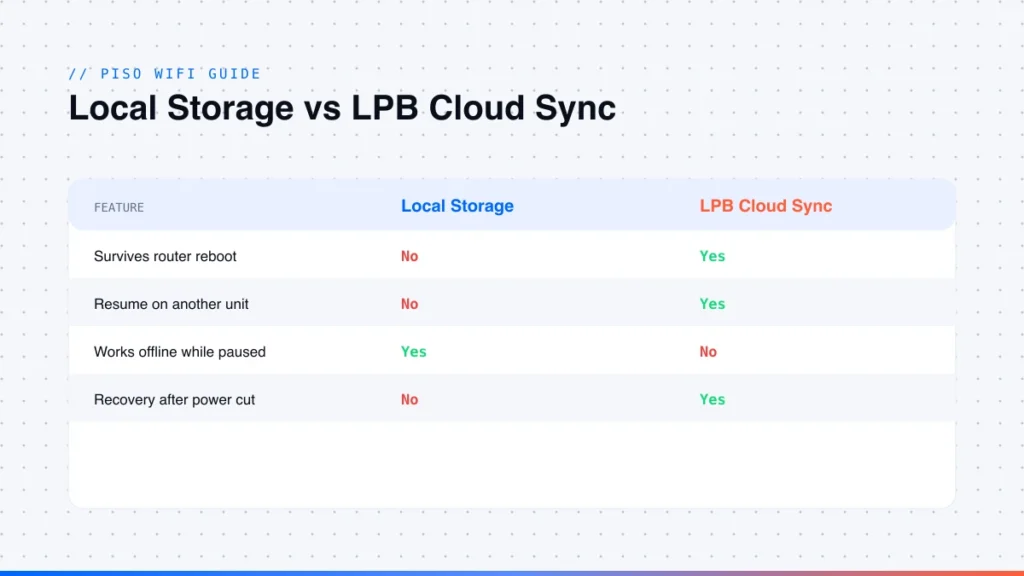
The most widely deployed platform, with roughly 420,000 active units across 21 distributors. The pause button appears directly below the session timer. LPB requires admins to enable pause in both Insert Coin Mode and Voucher Code Mode — enable only one and users on the other method won’t see the button. LPB 2.0 stores session data in the LPB Cloud, so paused sessions survive a router reboot and can be resumed at a different LPB unit anywhere in the Philippines.
AdoPiSoft
- menu Session Controls → Pause Time
- default
- admin/admin · administrator/admin1234
The second-most-common platform. It runs its own captive portal and uses a different default rate from LPB. Pause Time sits under Session Controls. Older units use admin/admin; newer units use administrator/admin1234. Don’t assume LPB defaults work here.
JuanFi
A MikroTik-based open-source alternative; the admin layout varies by version and configuration, and pause time depends on the operator setup. There is no LPB Cloud equivalent — sessions are stored locally, so a reboot during a pause wipes the session. Best for technically experienced operators who want full control without a licensing fee.
PisoFi
- menu Settings → Session Management → Pause/Resume
- default
- administrator / admin12345
Supports pause time as a built-in feature, configured from Session Management in the admin panel.
Makati PisoNet
- menu Advanced Settings → User Features → Pause Time
- default
- Check the router sticker
Supports pause time as a built-in feature under User Features. Default credentials are printed on the router sticker.
- Supported ≠ switched on
If your system uses a different local IP, check our configuration steps for the 20.0.0.1 network address.
- // For users
How to Use Piso WiFi Pause Time as a User
If the admin has enabled the feature on the machine you’re using, the process is quick.
Pausing Your Session
http://10.0.0.1 — type it in the address bar, not the Google Search bar- iPhone
- Laptop
http://10.0.0.1in the browser address bar. Typed into Google Search by mistake, you’ll get search results instead of the portal.Resuming Your Session
http://10.0.0.1 in your browser- Same device
mean the system can’t find your session.
How to Enable Pause Time as a Piso WiFi Admin
Users can't turn the feature on themselves. If the Pause Time button isn't showing, the owner must enable it from the
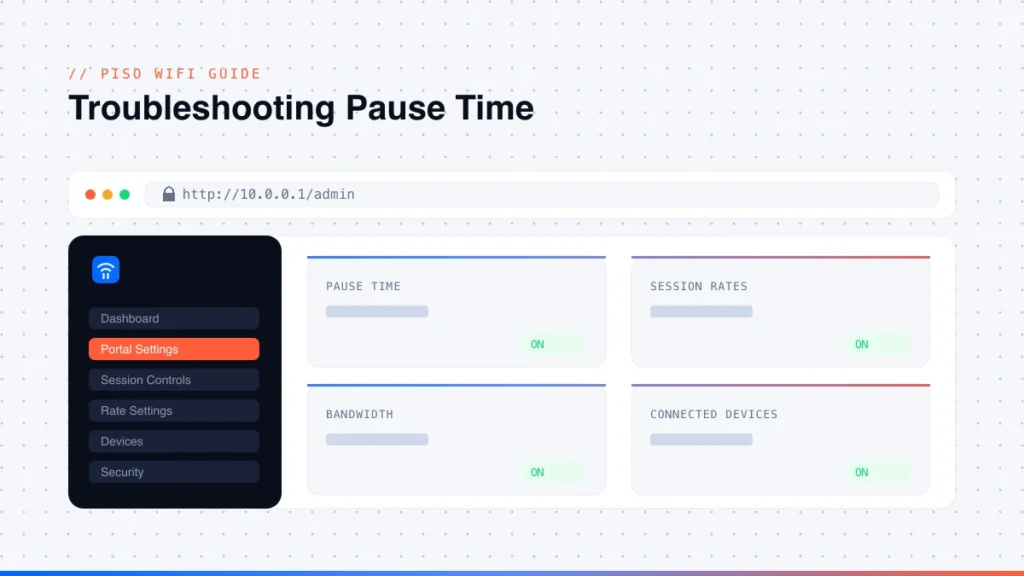
admin panel at 10.0.0.1/admin.
- 10.0.0.1/admin
- // Portal Settings
LPB Piso WiFi
ON
Pause Limits
- The LPB factory-default password is 123456789, the same on every unit that ships. Change it immediately after first login — anyone on your network who knows this default can access your admin panel.
- // General admin steps
Connect your phone or laptop to the Piso WiFi network you manage
Open Chrome and go tohttp://10.0.0.1/admin
Enter your admin credentials
Find Portal Settings, System Settings, or Session Management (depending on your platform)
Locate the Enable Pause Time or Pause/Resume toggle
Turn it on
Set your pause limits (duration, attempts, auto-expiry)
Save and reboot if the system prompts you
Test by connecting as a regular user and confirming the Pause Time button appears
- Platform-specific paths
Pause Limits
PisoFi
- Platform-specific paths
AdoPiSoft
Makati PisoNet
- LPB note: enable pause under both Insert Coin Mode and Voucher Code Mode — enabling only one means half your users never see the button.
For those running a business, we have a dedicated setup and troubleshooting guide for every Pisofi operator to maximize profits.
How to Disable Pause Time
Some operators turn pause off entirely. The steps mirror enabling it.
- // When to disable pause time
High-traffic location
Very high-traffic location where paused sessions block slots during peak hours.
Abuse
Buggy firmware
Transient audience
- The trade-off
- / 10.0.0.1/admin
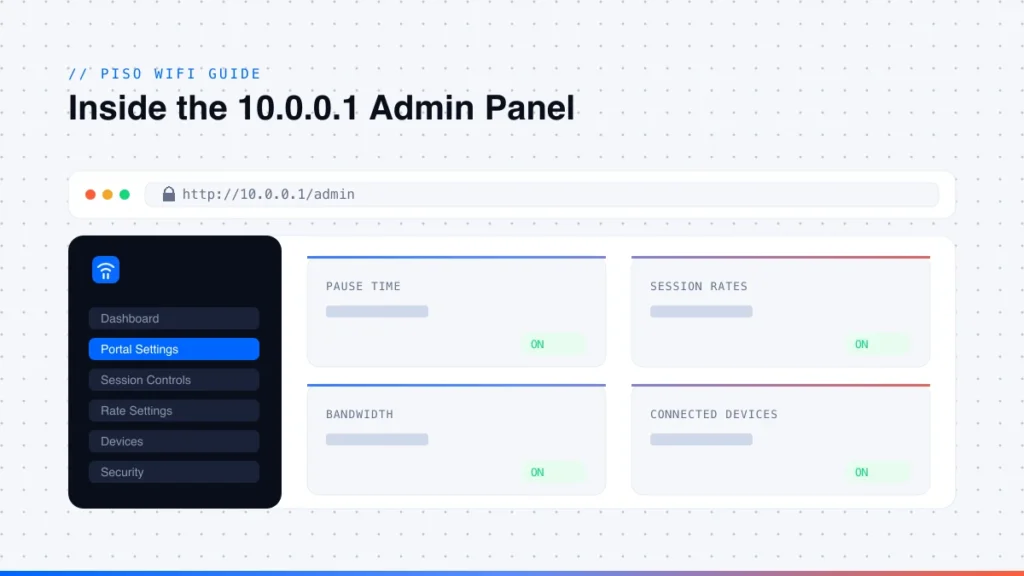
Accessing the Admin Panel at 10.0.0.1
The admin panel is where all machine settings live — pause time, pricing,
payment options, bandwidth limits, and session controls.
- What you can control
- Enable or disable Pause Time (under Portal Settings)
- Set session rates: minutes per ₱1, ₱5, ₱10, ₱20
- Configure GCash and Maya payment options
- Set bandwidth limits per user
- Monitor connected devices and active sessions in real time
- View revenue and transaction logs
- Generate voucher codes
- Configure MAC filtering and firewall rules
- Schedule auto-reboot (3 AM is the standard for LPB machines)
- Update router firmware
- How to log in
Connect to your Piso WiFi network or use a LAN cable directly to the router
Open Chrome and go tohttp://10.0.0.1/admin
Enter your credentials
| Platform | Username | Password Post |
|---|---|---|
| LPB Piso WiFi | admin | 123456789 |
| AdoPiSoft | administrator | admin1234 |
| PisoFi | administrator | admin12345 |
| Tenda-based units | admin | admin |
- If defaults don't work
10 seconds to restore factory defaults — but a full reset also wipes all custom settings (rates, SSID, session rules).- Security
Ready to start your own passive income business? Find out exactly how to request Piso Wifi vendo machine for your location.
- // Under the hood
How Piso WiFi Pause Time Works
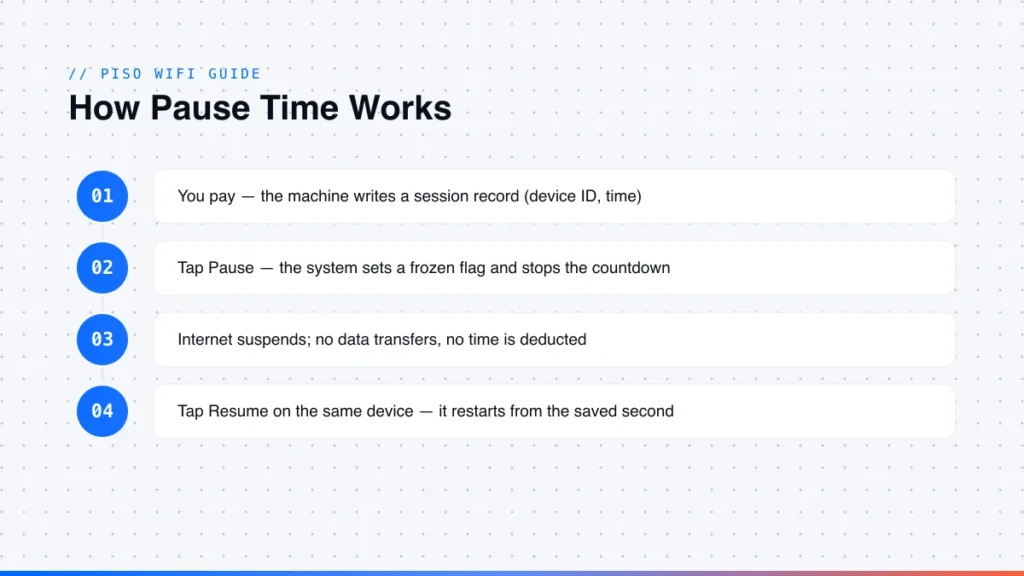
When you pay for a session, the machine writes a session record — your device’s MAC or IP address, a session ID, and your remaining time. When you tap Pause, the system sets a “frozen” flag on that record; the internet connection to your device cuts off, no data transfers, and the countdown stops.
When you tap Resume on the same device, the system matches your device ID to the stored session record and restarts the countdown from the saved point.
| Feature | Local Storage | LPB Cloud Sync |
|---|---|---|
| Survives router reboot during pause | ✕No | ✓Yes |
| Resume on a different LPB machine | ✕No | ✓Yes |
| Works without internet during the pause | ✓Yes | ✕No |
| Session recovery after a power cut | ✕No | ✓Yes |
Local Storage = JuanFi, older firmware · LPB Cloud Sync = LPB 2.0
- Why it matters
- // Configuration
Pause Time Limits
Admins set the rules for how long and how often users can pause; getting these
right for your location affects both satisfaction and revenue.
- Max pause duration
How long the timer can stay frozen in one go.
- Pause attempts
How many times a user can tap Pause before it disappears.
- Auto-expiry
How long before the system cancels an abandoned paused session.
- Minimum remaining time
Prevents pausing a near-empty session.
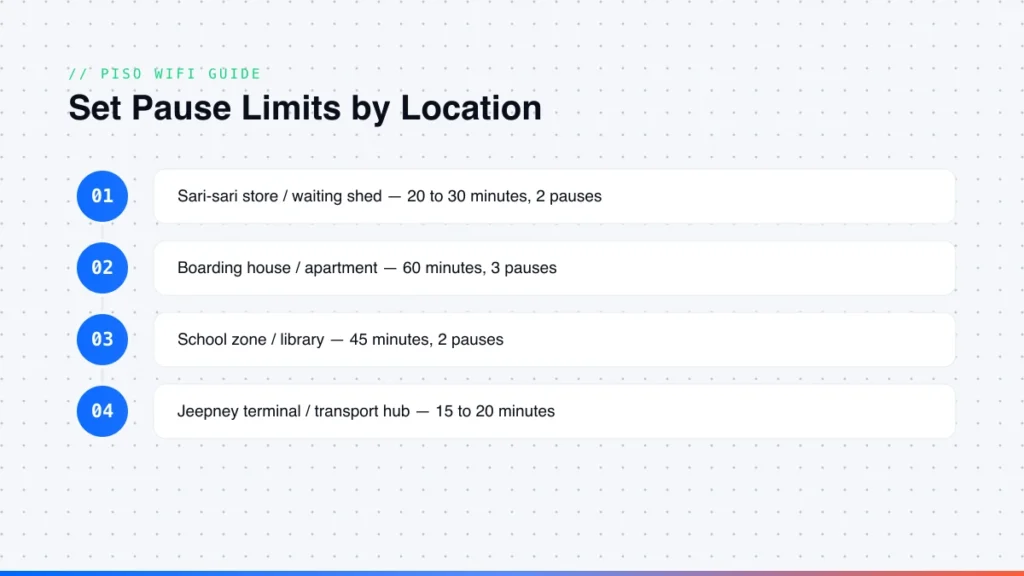
| Location Type | Max Pause Duration | Attempts | Auto-Expiry |
|---|---|---|---|
|
Sari-sari store / waiting shed
|
20 to 30 minutes
|
2 | 8 hours |
|
Boarding house / apartment
|
60 minutes
|
3 | 24 hours |
|
School zone / library
|
45 minutes
|
2 | 12 hours |
|
Jeepney terminal / transport hub
|
15 to 20 minutes
|
1 to 2 | 4 hours |
|
Internet kiosk / café
|
30 to 45 minutes
|
3 | 24 hours |
- Starting points
- // Troubleshooting
Why the Pause Button Is Not Showing
This is the most common complaint about Piso WiFi 10.0.0.1 pause time. A few
specific reasons cover almost every case.
- Clear your browser cache or use incognito (in Chrome: three dots → New Incognito Window → type
- Type the URL manually instead of relying on auto-redirect
- Make sure you're on the right network — a similar-named network or active mobile data can fool your phone
- Try a different browser; Chrome works best, Safari on iOS is a solid second
- Disconnect and reconnect to re-trigger the captive portal
- Log in to http://10.0.0.1/admin and confirm Pause Time is toggled on under Portal Settings
- On LPB, check both Insert Coin Mode and Voucher Code Mode separately
- Reboot the router after enabling
- Check firmware version — outdated firmware can stop the button rendering even when the setting is on
- Check if a minimum-remaining-time rule is blocking the button for near-empty sessions
- // Troubleshooting
Why Your Paused Session Might Not Resume
Pressing Resume and getting nothing back is frustrating. Each cause below has a specific fix.
Session Expired Before You Resumed
Very high-traffic location where paused sessions block slots during peak hours.
Device ID Mismatch
IP Address Changed
Portal Loaded Incorrectly
- // Reference
Troubleshooting Pause Time Issues
Match the symptom to its likely cause and the fastest fix.
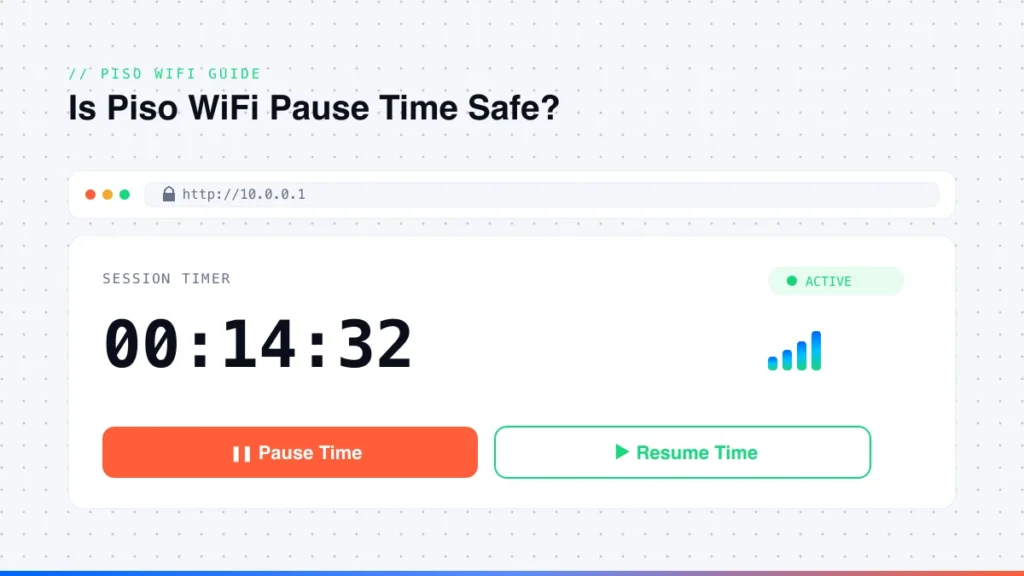
Is Piso WiFi Pause Time Safe?
Yes — the pause feature itself is safe for both users and operators. Here's exactly what
happens to your data.
- What's stored during a pause
- Session ID, device MAC address or IP address, and remaining time
- This data lives on the machine's local storage, or in the LPB Cloud for LPB 2.0 units
- No payment data is stored on the machine after the transaction completes
- No browsing history is recorded by the pause function
- The owner can view connected device MAC addresses and session logs through the admin panel — standard for any WiFi router
- Public WiFi security for users
- Piso WiFi portals operate over HTTP, not HTTPS — traffic between your device and the portal page is not encrypted.
Avoid logging into banking apps, email, or anything sensitive on public WiFi
If you must access sensitive accounts, turn on a VPN first
The Chrome pause-time process in particular is safe — Chrome sandboxes tabs, handles captive portals cleanly, and flags non-HTTPS connections
- For operators
- Change the default password immediately (123456789 ships on every LPB unit)
- Enable MAC filtering to restrict which devices can access the admin panel
- Schedule auto-reboot at 3 AM to clear session logs and prevent memory buildup
- Don't share admin credentials with customers
- The one genuine risk
- // For operators
Pause Time Tips for Piso WiFi Operators
Patterns that come from real operators running machines across the Philippines.
“A user who lost ₱10 to a dead session hedges with ₱5 buys; a user who trusts pause regularly spends ₱10 to ₱20 at a time.”
Tell customers it exists
Most users don’t know. A small sign — “You can pause your session and resume later” — reduces
complaints and builds trust.
Enable pause under both modes on LPB
LPB separates Insert Coin Mode and Voucher Code Mode; enabling only one hides the button from the
other payment type. The single most common LPB config mistake.
Set limits based on your location
Boarding houses/apartments: 60-min max, 3 attempts. School zones: 45-min max. Sari-sari
stores/waiting sheds: 20–30 min. Jeepney terminals/transport stops: 15–20 min.
Watch session logs for abuse
Same device pausing 5+ hours daily occupies a slot without revenue during peak. Tighten auto-expiry
to 6–8 hours and cap at 2 pause attempts.
Keep firmware updated
Pause time gets specific bug fixes in LPB and AdoPiSoft cycles; check at least once a month.
Change the default admin password
LPB default 123456789 is on every unit and is not a secret; change it the day you set up the machine.
- // Compare
Pause Time vs Auto-Expiry
Two settings that are often confused but work very differently.
Pause Time
User-controlled
The customer taps a button and the timer freezes
on their own terms.
Controlled by
User (if admin enables it)
What it does
Freezes timer on request
Auto-Expiry
Admin-controlled
If a session stays paused too long with no resume, the system cancels it to free the slot.
Controlled by
Admin
What it does
Cancels session after set inactivity period
- How they interact
- // Background
What Is Piso WiFi?
Piso WiFi is a coin-operated or voucher-based public internet access system built for the Philippine market. “Piso” is the Filipino word for ₱1 peso, reflecting the original model of inserting one-peso coins for short bursts of internet time. By 2026, machines accept coins, GCash, Maya, and QR codes, with packages from ₱1 for a few minutes up to ₱20 for extended sessions.
The owner buys a broadband connection or uses an LTE SIM, connects it to a vending unit with a coin slot and control board, and earns income reselling access in small increments. LPB alone claims around 420,000 active units nationwide across 21distributors. Machines appear in sari-sari stores, boarding houses, jeepney terminals, barangay halls, and waiting sheds, especially where personal broadband isn’t affordable or available.
// How a typical session works
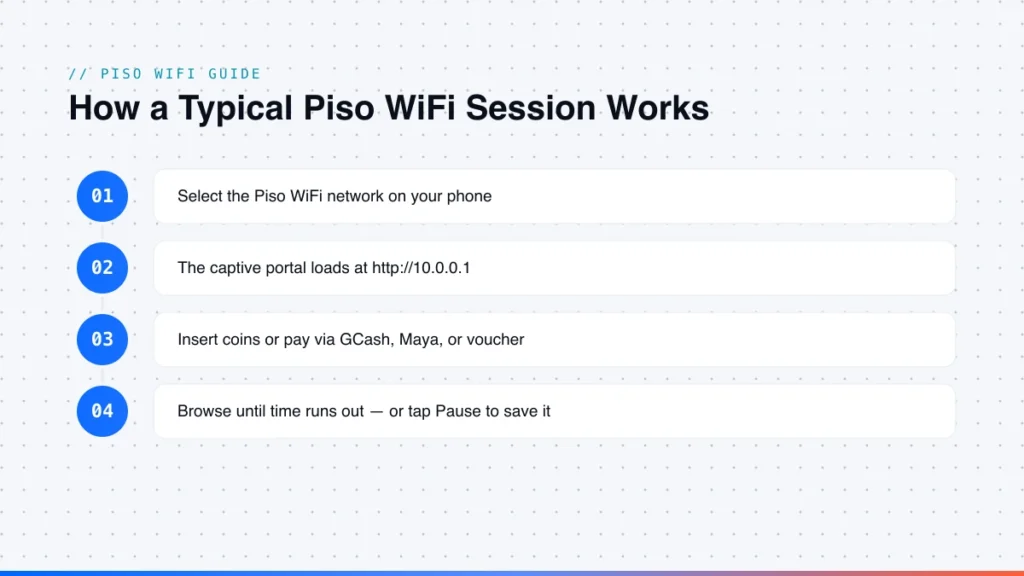
The customer selects the Piso WiFi network on their phone
Browser redirects to the captive portal at http://10.0.0.1
Customer inserts coins or pays via GCash, Maya, or voucher
Machine credits internet time based on the amount paid
Customer browses until time runs out or they tap Pause
Remaining time is saved; customer resumes later or inserts more coins to continue
- The control centre
http://10.0.0.1 is where users pay for and manage sessions; admins use http://10.0.0.1/admin to configure every setting. The three most widely used firmware platforms — LPB Piso WiFi, AdoPiSoft, and JuanFi — all use the same 10.0.0.1 gateway. The LPB 10.0.0.1 pause time feature is the most searched because LPB is the most commonly deployed platform.- // FAQ
Frequently Asked Questions
The questions users and operators ask most about Piso WiFi pause time.
What does Piso WiFi Pause Time actually do?
How long can I pause my Piso WiFi session?
Why is the Pause button not showing on my portal?
The most likely reason is that the admin has not enabled the feature. Try clearing your browser cache or opening http://10.0.0.1 in an incognito window first. If the button still does not appear, it is disabled at the admin level and cannot be activated as a user.
Can I resume my Piso WiFi session on a different phone?
No. Sessions are matched by device ID, usually your MAC address. A different phone will not match the stored session record. On LPB 2.0 with cloud sync, resuming on a different LPB machine is technically possible, but the device ID matching still applies in most implementations.
What happens if my paused session expires?
The system cancels the session, and your remaining time is gone. You will need to pay for a new session. There is no way to recover expired time.
Is Piso WiFi Pause Time available on all machines in the Philippines?
No. Most modern Piso WiFi software, including LPB, AdoPiSoft, and PisoFi, supports it as a built-in feature. But every machine owner enables or disables it independently.
What are the login credentials for the Piso WiFi admin panel?
Credentials vary by platform. LPB Piso WiFi defaults: admin / 123456789. AdoPiSoft: administrator / admin1234. PisoFi: administrator / admin12345. These are factory defaults and should be changed after the first login.
Can I pause time if I am using GCash or Maya instead of coins?
Yes. The payment method does not affect how pause time works once your session is active. Coins, GCash, Maya, and voucher codes all create the same type of session.
A break should never
cost your balance.
Pause time freezes your timer so stepping away never burns your paid minutes. Remember: it only appears when the owner has enabled it, and you should always resume on the same device.